

Article by
Frank Sweeney
An HOA in Ocala may require you to clean your home’s exterior when the community’s recorded governing documents support that standard. Florida Statute 720.3035 ties an association’s authority over architectural and appearance matters to those documents, while Florida Statute 720.305 requires at least 14 days’ written notice and a right to a hearing as part of the fining process. That doesn’t automatically make 14 days your cleaning deadline: the cure period depends on your community’s rules and the notice.
A pressure-washing notice for HOA compliance in Ocala can come as a surprise, especially when it points out grime or staining you hadn’t noticed. Start by reading the notice closely, identifying the cited surface and rule, and planning the right cleaning before the deadline. This guide explains how to read the notice, document the work, and respond clearly, while avoiding common mistakes that can turn a straightforward wash into a larger problem.
Key Takeaways
- Read the notice for its stated cure deadline and the community rule it cites; Florida’s fining process includes at least 14 days’ written notice and a right to a hearing.
- Dirty driveways, stained siding, and roof streaks can prompt exterior-maintenance notices, but the standards and consequences depend on your community’s governing documents.
- If the notice uses a vague appearance standard, ask which provision in the governing documents applies, then keep a record of the completed cleaning.
- Match the cleaning method to the surface. High pressure can damage some exterior materials, so roofs call for a gentler approach.
- After cleaning, send the HOA clear before-and-after photos and keep the service date and receipt with your records.
1. How long do I have to clean my siding after an HOA notice?
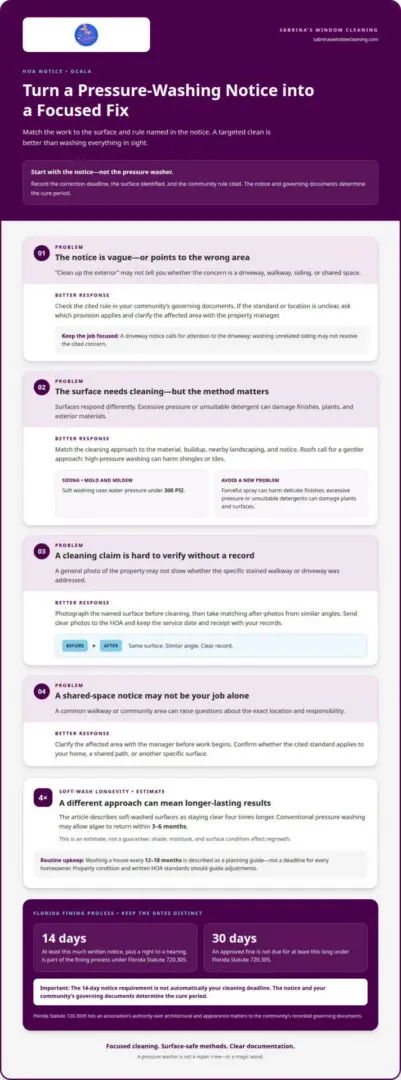
Start with the deadline printed in your notice. In Florida, Florida Statute 720.305 requires at least 14 days’ written notice and a right to a hearing as part of the fining process. That is not automatically your cleaning deadline. Florida Statute 720.3035 does not set a fixed cure period for exterior-maintenance violations, so your community’s governing documents and notice determine the time to correct the issue.
For example, an HOA may flag a dirty driveway, algae-stained siding, or dark roof streaks. These are examples, not a universal Ocala fine schedule. Check the notice and community rules for the cited standard, the correction deadline, and any stated penalty. An approved fine is not due for at least 30 days under Florida Statute 720.305.
A cleaning notice and a repair notice require different responses. Washing may remove surface grime, mildew, or algae, but it won’t fix cracked siding, loose boards, failing paint, or damaged caulk. If the notice describes physical damage, treat that as a separate issue. Pressure washing removes buildup; it does not restore broken materials, and washing damaged siding too aggressively can make the problem worse.
For mold and mildew on siding, soft washing uses water pressure under 300 PSI. Conventional pressure washing may allow algae to return within 3 to 6 months; soft-washed surfaces are described as staying clear four times longer. Treat that longevity as an estimate, since shade, moisture, and surface condition affect regrowth. Avoid forceful spray on delicate finishes.
How should you choose a licensed and insured pressure-washing company in Ocala? Ask the company to provide its license and insurance details, then discuss siding material, stains, and the notice deadline. Do Ocala or Marion County codes require washing homes, driveways, or sidewalks? The information here establishes no general washing requirement; an HOA’s appearance rules come from its governing documents.
Are there Ocala or Marion County runoff rules? Follow applicable local instructions for wastewater disposal, and keep detergent runoff away from sensitive landscaping. Can pressure washing harm landscaping, paint, stucco, shingles, or concrete? Yes. Excessive pressure or unsuitable detergents can damage finishes and plants, and high-pressure roof washing can harm shingles or tiles.
2. Pressure washing to meet community standards
Community standards often focus on the visible condition of a property’s exterior. A clean driveway, walkway, or shared area can make a clear difference in the neighborhood’s appearance. Pressure washing can remove stubborn surface debris and stains, helping homeowners address the specific concern in a notice instead of washing without a defined purpose.
Match the cleaning plan to the HOA notice. If it names a driveway, focus on that area; if it identifies a walkway, washing the siding won’t resolve the cited concern. A property manager can clarify whether the standard applies to an individual home, a shared path, or another specific surface. That distinction keeps the work focused on the violation.
Surface condition matters. Concrete, painted surfaces, and siding respond differently to water pressure and cleaning methods. A careful assessment considers the material, visible buildup, nearby plants, and the result required by the community standard. The goal is to remove grime without causing a new problem, such as stripping paint or disturbing landscaping. A pressure washer isn’t a magic wand, even if it makes a satisfying noise.
For routine upkeep, a preventive schedule can include washing a house every 12–18 months. That interval is a planning guide, not a deadline imposed on every Florida homeowner. Shaded walls, damp areas, and nearby trees can affect how quickly exterior surfaces collect grime. The condition of the property and the HOA’s written standards should guide adjustments to the schedule.
Keep the work focused and easy to document. Before cleaning, note the surfaces named in the notice and photograph them. Afterward, take matching photos from similar angles. For example, if the concern is staining on a front walkway, document that walkway before and after rather than sending unrelated pictures of the whole property. Clear records show what changed.
Shared spaces call for coordination. If a notice concerns a common walkway or another community area, clarify the affected area with the manager before work begins. This helps prevent duplicated effort and distinguish an individual responsibility from a community-maintenance issue. The condition, location, and governing standard all matter.
Professional pressure washing can help address exterior buildup when the required surfaces need careful, consistent cleaning. A targeted approach keeps attention on the condition named by the association, rather than turning a compliance task into an unnecessary whole-property wash.
3. Steps to take after receiving a pressure-washing notice
Read the full HOA notice before arranging cleaning. Note the letter date, correction deadline, surfaces named, and rule cited. Check the notice carefully, because the deadline may depend on the notice and your community’s rules. For pressure washing tied to an HOA compliance letter in Ocala, that date is the first detail to record. Add the deadline to your calendar so it doesn’t slip by while the letter sits on the counter.
Next, compare the alleged violation with your community’s covenants, conditions, and restrictions, often called CC&Rs. These documents set out the appearance and maintenance standards homeowners are expected to follow. If the notice says only “poor exterior appearance,” ask in writing which provision applies. A specific rule helps clarify whether the concern is siding, driveway staining, or another condition.
Keep your response focused and courteous. Confirm that you received the notice, identify the cited surface, and explain what action you plan to take. If the deadline is tight, contact the association or property manager promptly to discuss the schedule. For pressure washing after an HOA compliance letter in Ocala, specify which area needs attention and keep a copy of your message and any reply. A dated email creates a clearer record than a conversation remembered differently by each person.
Arrange cleaning for the surface named in the notice, then record what was done. Save the service date, the surfaces treated, and the invoice or receipt. If the letter concerns algae on the front siding, record that specific area rather than describing the job as general exterior work. These details connect the completed work to the HOA’s stated concern.
How do you document completed pressure washing for an HOA compliance response? Take before-and-after photos of the cited area from similar angles, then send them with a brief written update. Include the completion date and surface addressed, and keep copies of the photos, message, and receipt together. Clear evidence helps the association understand what was done, even if a board member didn’t see the cleaning.
If a fine is proposed, read the notice’s hearing instructions and respond within the stated process. Under Florida Statute §720.305(2)(e), a fine cannot be imposed if you cure the violation before the hearing or in the manner specified in the notice. According to the Florida Legislature, a fine hearing must be held before a committee of at least three members who aren’t association officers, directors, or employees.
Once you’ve addressed the cited issue, send your written response using the method stated in the notice. Keep proof of delivery and the association’s reply with your records. If streaks remain after cleaning, photograph them and describe the condition accurately rather than claiming the issue is fully resolved. A tidy paper trail beats reconstructing events from memory.
4. Common HOA pressure-washing standards
A pressure-washing compliance letter should identify the concern, affected surfaces, applicable community standard, and correction deadline. It might describe staining on siding, grime on a driveway, or streaks on another exterior area. Read the full notice before choosing a cleaning method. Address the named condition without assuming every surface needs the same level of cleaning.
To find the rules in an Ocala HOA’s covenants and architectural guidelines, review the recorded governing documents, community rules, and later amendments. Look for terms such as exterior maintenance, appearance, cleanliness, and architectural control. Check the association portal or resident packet if you have one. If a notice cites only a vague standard, ask the association or manager in writing to identify the specific provision.
Standards vary by community and surface. A driveway may need attention for visible staining, while siding may be cited for algae or mildew. A concern about dirty windows calls for a different cleaning task than buildup on concrete. Match the work to the notice rather than assuming one routine covers every exterior feature.
Pressure level matters. Pressure above 1,000 PSI can damage vinyl siding, so forceful spray is not a safe default for every home. A gentler method is especially important around delicate finishes, joints, and trim. On roofs, use low-pressure soft washing rather than high pressure. Strong spray can harm roofing materials, turning a cleanup task into an expensive repair problem.
Before washing, assess the surface and surrounding area. Look for loose paint, cracked stucco, open joints, or damaged concrete, as these conditions can affect how cleaning should proceed. Move or protect nearby items that should stay dry, and account for plants near the work area. Rinse detergent thoroughly so residue doesn’t dry on the siding or affect vegetation.
Choose a method that suits the property’s condition. A stained driveway may need focused cleaning, while a window or painted wall calls for an approach suited to its material. More pressure doesn’t always produce a better result. The right method removes visible buildup while protecting the surface beneath it, which is the point of maintaining the property to an HOA standard.
After the work, compare the treated area with the notice. Take clear photos of the cited surfaces, including any remaining marks, and keep them with your written response. If the standard concerns a specific driveway section or siding wall, photograph that exact spot. A focused record makes it easier for the association to see whether the stated condition has been addressed.
5. Ocala HOA exterior maintenance notices
Ocala homeowners may see exterior-maintenance notices during the summer compliance period, which runs from June through September. HOA enforcement of exterior appearance guidelines is reported as stricter during summer 2026. For a homeowner, the practical takeaway is simple: take a notice seriously, read its deadline, and identify the exact area it names. A stained wall, visible mildew, or algae-covered surface calls for a focused response, not a guessing game with the garden hose.
Florida’s summer conditions can help exterior algae and fungi grow quickly. The University of Florida IFAS Extension says their populations can double in size during the summer months. That helps explain why mildew on a shaded wall or buildup near damp areas may become more noticeable. It doesn’t mean every home will receive a notice, but it makes seasonal inspections useful. Check your exterior in spring and fall, paying attention to shaded siding, walkways, and roof surfaces.
Ocala’s seasonal pattern makes timing worth considering. If you receive a notice during the June-to-September period, compare its deadline with the scope of the work. A small stained walkway and widespread buildup across siding call for different plans. If cleaning needs scheduling, act promptly and keep the association informed in writing. Don’t assume summer creates a new deadline or changes your community’s rules. The notice and governing documents remain the key references.
Match the method to the material named in the letter. Soft washing uses low pressure and may suit delicate exterior surfaces better than a forceful spray. Roofs, siding, painted trim, and concrete have different cleaning needs, so one setting isn’t right for every surface. If the notice identifies mildew on siding, address that siding. If it names a driveway stain, focus there. Cleaning an unrelated area won’t answer the association’s specific concern.
Keep a clear paper trail for your Ocala HOA response. Photograph the cited area before cleaning, save the service date and receipt, then take after photos from similar angles. Send the association a brief written response identifying the completed work. Label images “north-facing siding,” for example, rather than “house,” so the board can connect them to its notice. A little organization beats a camera roll full of mystery stains.
For routine prevention, schedule exterior inspections in spring and fall, then note any mildew or stained areas before they draw attention. If a summer notice calls for exterior cleaning, schedule pressure washing for the specific surfaces it identifies. A targeted cleaning plan and clear photos help keep the focus on the actual compliance issue.
Sabrina’s Window Cleaning: Pressure Washing
Sabrina’s Window Cleaning provides pressure washing for exterior surfaces named in an HOA notice, such as a stained driveway or dirty siding. For roof streaks, the company also offers Soft Wash Roof Cleaning, a low-pressure approach suited to roof cleaning. The right service depends on the surface and the condition described in your letter.
Have the notice handy when scheduling so the affected area and deadline are clear. This keeps the cleaning focused on the issue your association identified, rather than on surfaces that weren’t cited. For homeowners addressing an exterior-cleanliness concern in Ocala, Sabrina’s Window Cleaning can provide a surface-appropriate cleaning service.
Contact Sabrina’s Window Cleaning to discuss the exterior cleaning described in your HOA notice.
Make your next exterior-care step a clear one
Use the notice as a prompt to plan ahead, not just to react. Once you’ve addressed the cited concern, note which exterior areas tend to collect grime and set a simple maintenance reminder based on your home’s needs. That way, the next season is less likely to catch your siding or driveway auditioning for a mud-stain documentary.
If an Ocala HOA compliance letter calls for pressure washing, choose work that matches the named surface and your association’s expectations. Sabrina’s Window Cleaning offers Pressure Washing, Window Cleaning, and Hurricane Shutter Installation. Each addresses a different exterior-care need, so focus on the service that fits your current task.
For help with the cleaning work described in your notice, contact Sabrina’s Window Cleaning. A clear starting point is the area named in the letter and the outcome you need. Take the next step with care, and give your home’s exterior a fresh start.
Frequently Asked Questions
Can my HOA really force me to pressure wash my house?
An HOA can enforce exterior appearance standards when its authority comes from the community’s recorded governing documents. Florida Statute 720.3035 ties architectural and appearance controls to those documents. That doesn’t mean every stain automatically justifies a washing demand. Compare the notice’s cited rule with the specific condition, such as visible mildew on a wall, and determine whether the rule addresses cleaning, repairs, or another corrective action.
How much can an HOA fine me for dirty siding?
Florida Statute 720.305 generally limits a fine to $100 per violation; a continuing violation’s aggregate daily fines are capped at $1,000 unless the governing documents provide otherwise. The amount that applies to a dirty-siding notice depends on the association’s enforcement rules and the circumstances. Review the written notice for its stated amount, alleged violation, hearing process, and payment timing before treating a proposed fine as final.
Can I Get Ahead of Violations With a Maintenance Schedule?
Yes. A maintenance schedule can help you spot changes before they lead to a notice. Keep a simple property log with the date, surface inspected, and observations, such as new discoloration on a shaded wall or buildup near a walkway. Add occasional photos from consistent viewpoints. This creates a useful record of changing conditions and helps you plan cleaning around actual needs rather than waiting for a letter.
Can the HOA fine me again if the mildew comes back?
A returning stain may prompt another notice if the association considers it a current violation under its governing documents. Keep records showing when the original condition was cleaned and which areas were treated. If mildew reappears, document its location and extent rather than assuming it is the same unresolved issue. The association’s rules and notice process determine how a recurring condition is handled.
How fast can you clean before my HOA deadline?
The time required depends on the surfaces named, the amount of buildup, and the work involved. Cleaning one accessible driveway is a different scope from treating mildew across several exterior walls. Let the deadline in your HOA notice guide planning: first identify the affected areas and the result required. That gives the cleaning a clear scope without assuming a completion time.
How long do I have to clean my siding after an HOA notice?
Your notice and community governing documents determine the cure deadline; Florida Statute 720.3035 sets no fixed cure period for exterior-maintenance violations. The 14-day written notice requirement under Florida Statute 720.305 relates to the fining process, not a universal cleaning window. Note the letter date and any stated correction date, then compare the cited siding standard with your community’s rules.
How much time do I have before an HOA fine takes effect?
Florida Statute 720.305 requires written notice and an opportunity for a hearing before a fine is imposed. An approved fine isn’t due for at least 30 days. Those are separate stages: the notice and hearing process comes before an approved fine’s payment period. Read the association’s letter for the hearing instructions and dates, and keep copies of any written response you send.
How quickly can Ocala pressure-washing companies complete work before an HOA deadline?
Completion timing depends on the job’s scope, the surfaces involved, their condition, and scheduling. One stained driveway presents a different task from siding, walkways, and other areas named together in a notice. In Ocala, first write down each cited surface and the deadline. A clear scope makes it easier to plan around the association’s requirements without assuming every property takes the same time.
Disclaimer
All articles are designed to entice you to hire Sabrina's to clean your windows, not to teach you how to clean them. They are meant for entertainment purposes only. We are not responsible for the out come of your DIY cleaning project!