

Article by
Frank Sweeney
For hurricane shutter installation in Boca Raton, permit handling depends on the property’s location: the City of Boca Raton handles permits in East Boca, while Palm Beach County handles them in West Boca. Aluminum shutters satisfy Florida Building Code requirements, and HOA rules are a separate consideration to address during the project.
Choosing storm protection is about more than getting shutters onto the house before the weather turns. You want an option that suits the home, meets applicable requirements, and fits your community’s guidelines, without the planning process becoming a storm of its own. This guide explains the differences between hurricane shutters and impact windows, what to consider when planning installation, and how local permitting and HOA review fit into the picture. You’ll also learn what professional installation involves and how to approach the next steps with greater confidence.
Key Takeaways
- Compare shutter and impact-window options by your home’s age, the openings that need protection, and how you prefer to prepare for storms.
- Plan for the specific needs of windows, sliders, balconies, and lanais so each opening is accounted for.
- Keep HOA review and local permit requirements in your project plan as separate steps.
- Build maintenance into your storm-season routine: shutter tracks and thumbscrews need appropriate lubrication, and oily products can trap dirt.
- Learn what a professional installation plan should consider, from the property’s openings to the details that affect a careful fit.
Need a pro for your hurricane shutter service project in Boca Raton, FL?
Accordion shutters can protect openings such as windows and lanais. Choosing between shutters and impact windows also affects how you prepare each opening before storm season.
Accordion Shutter Applications
Accordion shutters can cover windows, sliding doors, balconies, and lanais. Start by listing each opening that needs protection, then note its type and location. A living-room slider, for example, needs a different coverage plan from a small window. Reviewing openings one by one helps prevent a vulnerable spot from being left out.
Boca Raton homeowners with homes less than 20 years old often choose accordion shutters. Impact windows are another option, and some homes combine both. For instance, a homeowner might use impact windows in selected rooms and accordion shutters for a balcony or lanai. The right mix depends on the openings and the protection approach planned for each.
Accordion Shutter Installation
A complete installation starts with an opening-by-opening review. Identify windows, sliders, balconies, and lanais, then match each opening with its planned shutter coverage. This keeps the work organized and makes gaps in the plan easier to spot. Clear access to each opening also helps the installation proceed methodically.
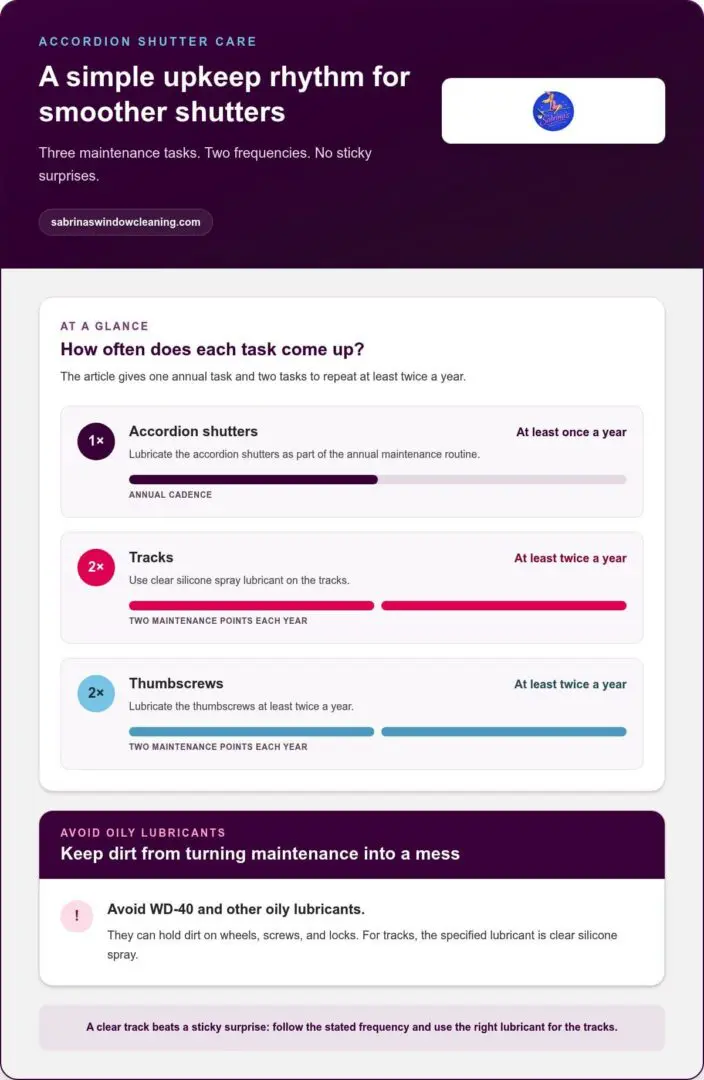
Maintenance belongs in the plan, too. Accordion shutters should be lubricated at least once a year. Tracks need clear silicone spray lubricant at least twice a year, and thumbscrews need lubrication at least twice a year. Avoid WD-40 and other oily lubricants: they can hold dirt on wheels, screws, and locks. A clean track is better than a sticky surprise.
Installation Time
Installation time depends on the number and arrangement of openings, access, and whether the project combines shutters with impact windows. A home with several sliders, windows, and a lanai has more locations to address than one with fewer openings. A mixed installation also requires planning two protection approaches instead of one.
For a useful schedule, make a complete opening list before work begins. Include each window, slider, balcony, and lanai, and note where furniture or landscaping may restrict access. This inventory helps define the work involved. The time required depends on the project’s actual scope, not a one-size-fits-all estimate.
Hurricane shutter and impact window installation in Boca Raton
Boca Raton homeowners can compare impact windows, accordion shutters, and hurricane screens by looking at each opening and the protection approach they want. Impact windows are popular with homeowners upgrading homes more than 25 years old. Accordion shutters offer a separate approach, while screens are another option to evaluate rather than assume equivalent. The choice affects both the home’s windows and how storm preparation fits into daily routines.
Compare the Options by Opening
Start with an inventory of windows, sliding doors, and other exposed openings. A home with a large living-room slider, for example, may need a different plan from one with several standard windows. Impact windows integrate protection into the window itself; shutters and screens cover openings. Consider how each option fits the opening and how you’ll use it outside storm preparation.
Hurricane screens and shutters aren’t interchangeable just because both cover an opening. Compare their intended use, how they fit each window or door, and the steps needed to prepare them. For a Boca Raton home with a mix of windows and sliders, assess every opening individually. This review helps show where one approach may be more suitable than another.
Choose a Combination That Fits the Home
Homeowners don’t have to choose one approach for every opening. A mixed plan could pair impact windows in selected rooms with accordion shutters on a balcony or lanai. List which openings will receive each treatment, including sliders and less prominent windows. This helps ensure that changing the approach on one side of the home doesn’t leave another opening out of the plan.
Impact windows are popular with Boca Raton homeowners upgrading homes more than 25 years old. That figure describes a common choice, not a rule that older homes must have impact windows. Compare the existing windows, the openings involved, and the protection approach desired. Estate shutters are described as lasting up to 50 years or longer, so the type of shutter matters when considering longevity.
Plan Installation Around the Details
Before installation, map each window and door to the selected option. Mark impact windows separately from shutters and screens, then include any balcony, lanai, or slider in the plan. This defines the project scope and helps prevent overlooked openings. A complete opening list is more useful than choosing a product based on one front-facing window.
For a Boca Raton property, compare options by how they serve the home as a whole, not by appearance alone. Ask how the chosen approach addresses each listed opening and how storm preparation will work there. A clear plan turns a collection of products into coordinated protection. Don’t overlook a window simply because it’s tucked around the side.
Hurricane shutter service locations, including Boca Raton
Boca Raton is the location in focus, but the property itself shapes the installation plan. A single-family home and a townhome may have different openings, access points, and shared exterior features. Identify the property type, then list the windows, sliders, balconies, and lanais to consider. This inventory gives the project a practical scope instead of treating every home like the same floor plan.
For a single-family home, walk around the exterior and note every opening, including side and rear windows. The front entrance isn’t the whole story; the lanai at the back deserves attention too. In a townhome, also note shared walls, neighboring units, and exterior areas managed by the community. These details clarify what belongs in the installation plan and what may need HOA review.
Location matters for permitting as well as scheduling. In East Boca, the City of Boca Raton handles hurricane shutter and impact window permits. In West Boca, Palm Beach County handles them. Identifying whether the property is in East or West Boca is a useful early step. A map can settle the neighborhood question more quickly than a debate over what counts as “west.”
Installation and repair are different project needs. For a new installation, describe the openings and property type clearly. If shutters are already in place, note which opening is involved and what issue you observe. This distinction keeps the project description accurate, whether the concern involves a new window, sliding door, or existing shutter. Clarify the scope before discussing work or timing.
For a Boca Raton home, provide the property’s location and whether it’s a single-family home or townhome. Don’t assume nearby Palm Beach communities follow the same permitting path as East or West Boca. Local boundaries can determine which office handles permits, so the specific neighborhood is more useful than a broad regional label.
Experience with hurricane protection work is most relevant when it translates into careful property-specific planning. A home with a lanai, several sliders, and a townhome’s shared exterior features calls for a more detailed opening list than a simple row of windows. Before installation, organize that list by location and opening type. The result is a clearer project scope, fewer overlooked spots, and a finish that accounts for the whole property.
Florida Building Code and HOA considerations
Before work begins, separate three project questions: code, community approval, and installation scope. Boca Raton’s hurricane protection rules are lower than those in Miami-Dade County. Aluminum shutters in Boca Raton satisfy Florida Building Code requirements. These facts provide a starting point, but they don’t replace reviewing the property’s specific permit and HOA process.
Permit handling varies by location. For East Boca, the City of Boca Raton handles hurricane shutter and impact window permits; for West Boca, Palm Beach County handles them. First identify which side of Boca Raton the property falls on. Then organize the proposed work by opening, such as bedroom windows, a front slider, or a lanai. A clear list helps keep permit details tied to the actual project.
HOA review is a separate step. Read the community’s architectural guidelines for rules about exterior appearance, colors, placement, and submission requirements. Then prepare a concise project packet with the opening list, shutter type, and any requested product details. For example, a townhome owner may need to show how a proposed shutter affects the visible front elevation. Keep HOA and permit documents together, but don’t confuse one with the other.
Insurance discounts and Florida tax incentives aren’t automatic results of installing shutters. Insurance treatment depends on the policy and insurer, while tax benefits depend on applicable program requirements. Keep installation and product records so you can discuss the project accurately with your insurer or tax adviser. Shutters provide protection, but don’t assume they will reduce every bill.
Florida contractor licensing deserves its own documentation step. Record the contractor’s license information separately from permit approvals and HOA decisions. These documents address different parts of a project. A clear file can include the work scope, permit paperwork, community correspondence, and installation records, labeled by property address and opening.
Describe any existing damage clearly. Note whether a shutter is bent, difficult to close, or detached from its track, and identify the affected opening. This makes it easier to distinguish a repair concern from a new installation. Don’t treat a repair description as proof that the shutter meets code: code compliance and the condition of an existing shutter are separate considerations.
In South Florida, a practical sequence is simple: identify the property location, review HOA instructions, organize opening details, and keep licensing and project records together. For example, an East Boca homeowner with a lanai and several windows can prepare one opening list to organize the separate approval steps. A tidy folder beats a paperwork scavenger hunt.
Professional hurricane protection installation in Boca Raton
Professional storm protection starts with a plan for the whole property, not just its most visible windows. In Boca Raton, list each opening, choose its protection approach, and define the installation scope before work begins. A front window, side slider, and covered lanai each belong in the plan. This careful start keeps the project focused on the home’s actual layout.
Begin with a property walkthrough. Record windows, sliding doors, balconies, and lanais, then mark which openings need protection. Note practical access details, such as landscaping beside a window or furniture near a slider. These observations give the installation team a clearer picture of the work and help you spot overlooked openings before the project moves forward.
Next, match the selected protection to each opening. A home might use accordion shutters on a lanai and impact windows elsewhere. Another property may need one approach across its windows and doors. The plan should account for every listed opening, rather than selecting products one at a time without considering the full exterior. A spreadsheet or simple room-by-room checklist can keep the choices organized.
Before installation day, prepare access to the work areas. Move patio furniture away from a lanai, clear items beside exterior windows, and keep the route to each opening unobstructed. For a townhome, include shared or community-managed exterior areas in the planning conversation. These steps help the installation proceed smoothly and reduce avoidable disruption to the surrounding property.
During the work, keep the opening list available as a reference. Follow the project location by location, checking off bedroom windows before moving to the living-room slider, for example. At the end, review the completed scope against the same list. This comparison makes omissions easier to notice and gives both sides a clear record of what the project covered.
A polished finish matters, too. Look over the work areas for leftover materials, note any care instructions provided, and keep project records with the property documents. For example, a homeowner can file the opening checklist and installation paperwork together, making future maintenance planning easier. The goal is straightforward: organized preparation, careful work, and a clear closeout, without turning storm protection into a scavenger hunt.
Ready to plan protection for your home’s openings? Schedule hurricane shutter installation as the next step toward a more organized project.
Sabrina’s Window Cleaning: Window Cleaning
Sabrina’s Window Cleaning provides hurricane shutter installation for Boca Raton homeowners planning storm protection, along with window cleaning to keep exterior glass clear. Once installation planning is underway, window cleaning can refresh the views around newly protected windows. It’s a practical pairing: one service prepares shutters, while the other cleans the glass, not the hardware.
Turn to Sabrina’s Window Cleaning when you’re ready to arrange hurricane shutter installation or want exterior windows cleaned as part of your property’s upkeep. Pressure washing and soft wash roof cleaning are also available for exterior maintenance. Each task has its place, whether you’re preparing shutters or cleaning other outdoor surfaces. Contact Sabrina’s Window Cleaning to discuss the service that fits your home.
Make Your Next Step a Simple One
A well-planned home project becomes easier to manage when you turn decisions into a short, practical task list. Note which openings need attention, keep relevant HOA paperwork together, and decide what you’d like handled first. That way, planning hurricane shutter installation in Boca Raton can move from a vague to-do into a clear next step, without adding another storm to your calendar.
Sabrina’s Window Cleaning can help with hurricane shutter installation, window cleaning, and pressure washing. Choose the service that fits your home’s current needs, whether you’re preparing shutters or refreshing exterior surfaces. No elaborate plan required. Just start with the task that matters most to you.
Contact Sabrina’s Window Cleaning to discuss your next project. A thoughtful start can make home preparation feel much more manageable.
Frequently Asked Questions
What types of hurricane shutters are available in Boca Raton?
Accordion shutters are one option, alongside hurricane screens and impact windows. Accordion shutters cover openings such as windows and sliders, while impact windows provide a different approach built into the window. Some Boca Raton homes use a mix, such as impact windows in selected rooms and shutters at a lanai. Compare how each option fits the opening and how you’ll prepare it before a storm.
Which hurricane shutters are best for homes in Boca Raton?
The best choice depends on the home’s openings, existing windows, and preferred preparation routine. Accordion shutters are often chosen for homes less than 20 years old, while impact windows are popular among homeowners upgrading homes more than 25 years old. These are common patterns, not rules. For example, a home with impact windows in some rooms could use shutters for a separate balcony opening.
Are permits required to install hurricane shutters in Boca Raton?
Permit handling depends on the property’s location. The City of Boca Raton handles hurricane shutter and impact window permits in East Boca; Palm Beach County handles them in West Boca. For hurricane shutter installation in Boca Raton, first identify the property’s location and permit jurisdiction. Then organize project details by the openings being addressed, such as bedroom windows or a patio slider.
What building codes and wind-load requirements apply to hurricane shutters in Boca Raton?
Aluminum shutters in Boca Raton satisfy Florida Building Code requirements. Boca Raton’s hurricane protection rules are lower than those in Miami-Dade County. For a specific home, consider the selected product and the openings it will cover rather than assuming one design fits every property. Keep product documentation with project records so the details remain connected to the installation scope.
How do I find licensed hurricane shutter installers in Boca Raton?
Look for an installer whose licensing applies to the proposed work, and keep the license details with the project records. Match them to a written scope identifying the openings and shutter work. For example, a proposal covering windows and a lanai should describe both areas clearly. Permit paperwork and HOA approval are separate records, so organize each rather than treating one as a substitute for the other.
What is the step-by-step process for hurricane shutter installation?
Start by listing the openings, then choose the protection approach for each one. Next, organize the project scope and applicable permit and HOA paperwork. Before installation, clear access to work areas, such as moving furniture away from a patio slider. Afterward, compare the completed work with your original list and keep the related project documents together.
What should I check before hiring a hurricane shutter contractor?
Review the proposed work scope, licensing details, and included openings. Check that the written description distinguishes windows, sliders, balconies, or lanais instead of relying on a broad phrase like “whole house.” For a townhome, note any community review requirements that could affect exterior work. Keep those details alongside permit records so the proposal, approval steps, and planned installation stay aligned.
How should hurricane shutters be maintained and stored?
Lubricate accordion shutters at least once a year, and lubricate tracks and thumbscrews at least twice a year. Use clear silicone spray lubricant on tracks; avoid WD-40 and other oily lubricants, which can hold dirt on wheels, screws, and locks. For seasonal removal and storage, keep shutter parts together and labeled by opening. That way, a bedroom panel won’t end up assigned to the lanai.
Disclaimer
All articles are designed to entice you to hire Sabrina's to clean your windows, not to teach you how to clean them. They are meant for entertainment purposes only. We are not responsible for the out come of your DIY cleaning project!