

Article by
Frank Sweeney
Sabrina died in 2020, leaving me a single father to the best daughter any dad could ever want. Hoping she doesn't notice my mistakes and when she does, try to make her think it was all part of the plan.
Why does your beautiful Florida view look like it’s being filtered through a crusty sea shell? If you’ve spent an entire afternoon scrubbing only to have those stubborn white spots laugh in the face of your spray bottle, you aren’t alone. It’s incredibly frustrating when a simple cleaning doesn’t cut it, leaving you worried that your expensive glass might be ruined forever. Those crusty ‘glass barnacles’ are actually calcium and magnesium deposits that have staged a hostile takeover of your windows.
The good news is that you don’t have to settle for a foggy outlook. This guide will teach you the secrets of hard water stain removal windows so you can reclaim your curb appeal before those minerals cause permanent etching. We’ve been protecting Florida homes since 1989, and we know exactly how to handle the unique challenges of coastal salt and mineral buildup. You’ll learn how to identify the severity of the damage, the professional methods that beat basic vinegar, and how to create a prevention plan that keeps your sprinkler system from ruinous overspray. Let’s get your windows back to their crystal-clear glory.
Key Takeaways
- Identify the “Florida Kiln” effect and how 90-degree heat turns simple minerals into stubborn “glass barnacles” on your windows.
- Master the basics of hard water stain removal windows using effective DIY household acids like vinegar before the minerals start eating the glass.
- Recognize the “Point of No Return” where surface stains transition into permanent etching that no amount of scrubbing can fix.
- Implement a strategic defense plan by adjusting your “sprinkler sabotage” and applying protective coatings to repel future mineral buildup.
- Learn why some mineral battles require the “heavy artillery” of professional restoration to ensure your windows survive the Florida elements.
The Science of the Spot: Why Florida Water Hates Your Windows
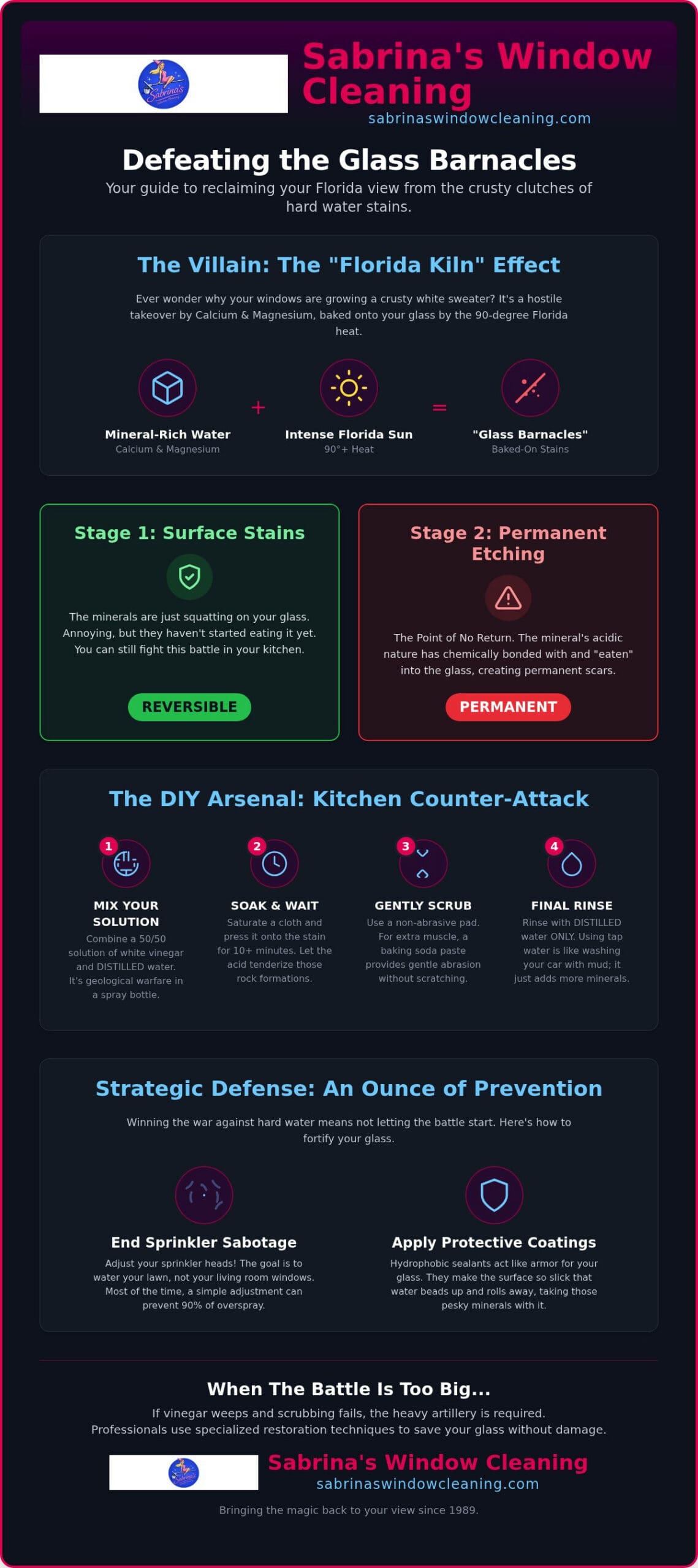
Ever looked at your windows and wondered why they’re growing a crusty white sweater? It’s not just dirt; it’s geology in action. When we dive into The Science of the Spot, we’re really talking about tiny rock formations that have decided to take up permanent residence on your glass. These “glass barnacles” are primarily composed of calcium and magnesium. In Florida, our groundwater is practically a liquid mineral supplement, and your windows are the unfortunate, non-consenting recipients of this high-dose treatment.
The “Florida Kiln” effect is where things get truly sticky. Imagine your windows are sitting in a giant oven. Our 90-degree heat doesn’t just dry the water; it bakes those minerals directly into the silica of your glass. If you live in coastal cities like Naples or Sarasota, the salt spray adds another layer of complexity. Salt acts like a magnet for moisture, which then traps even more minerals against the surface. It’s a never-ending cycle of crustiness that turns a beautiful sunset into a blurry, white-spotted mess.
There are two main levels to this mineral mess. Stage 1 is just a surface spot. It’s annoying, but the deposit is still sitting on top of the glass. Stage 2 is when the chemical bonding begins. This is where the minerals start to “eat” into the glass, creating a permanent scar. This is why timing is everything for hard water stain removal windows; catching it early means the difference between a simple cleaning and a total glass heartbreak.
Calcium, Magnesium, and the Periodic Table in Your Sprinkler
If you’ve noticed a white, chalky residue that refuses to budge, you can probably thank your irrigation system. Most Florida sprinklers pull from well water, which is loaded with dissolved minerals. When that water hits your hot windows and evaporates, the liquid disappears, but the minerals don’t have anywhere to go. They stay behind, stacking on top of each other until you have a miniature mountain range on your pane. It’s basically an unwanted science fair project happening right on your living room view.
Why ‘Just Rinsing It’ Actually Makes It Worse
It’s tempting to grab the garden hose and give the windows a quick spray to “clean” them off. Please, put the hose down. Unless you’re using deionized water, you’re just adding a fresh coat of mineral-rich tap water to the existing problem. You’re effectively feeding the barnacles. Glass surfaces are naturally hydrophilic, which means they have a strong affinity for water and tend to hold onto dissolved minerals as the liquid evaporates. By rinsing without proper drying or treatment, you’re just providing more raw material for the sun to bake into your glass during the next heatwave.
The DIY Arsenal: Hard Water Stain Removal with Household Heroes
Your kitchen pantry is secretly a high-stakes laboratory for geological warfare. Understanding Why Florida Water Hates Your Windows is the first step toward victory; now it’s time to choose your weapons. If you’re ready to tackle hard water stain removal windows yourself, you’ll need more than a positive attitude and a roll of paper towels. Sometimes, a bottle of white vinegar and a little patience can act as the “heavy artillery” for those early-stage spots before they turn into permanent scars.
Vinegar is the natural enemy of calcium because of its acetic acid content. It works by dissolving the mineral bonds that hold those “glass barnacles” in place. For more stubborn deposits, a baking soda paste provides a gentle abrasive that helps move the needle without turning your window into a scratched mess. Just remember that acidic runoff doesn’t play well with aluminum frames or your neighborly landscaping. Keep a damp cloth handy to wipe down the frames as you go. If the thought of spending your Saturday playing chemist feels overwhelming, you can always trust a professional window cleaning service to handle the heavy lifting for you.
Step-by-Step: The Vinegar Soak Method
Start by mixing a 50/50 solution of white vinegar and water to reach that perfect “salad dressing” level of acidity. Don’t just spray it and wipe it away immediately. You need to saturate a cloth and press it against the glass for at least 10 minutes. This gives the acid time to do the heavy lifting, essentially tenderizing those rock formations before you scrub. Finally, always use distilled water for your final rinse. Using tap water at the end is like washing your car with mud; you’re just putting the minerals right back where you found them.
The ‘No-No’ List: Tools That Will Ruin Your Day
Stay far away from steel wool and razor blades unless you’ve been trained to use them. One wrong move and you’ll trade a white spot for a permanent scratch that no amount of cleaning can fix. Similarly, those “magic” melamine sponges can be too aggressive for tinted or coated Florida glass, stripping away protective layers along with the stains. Always test a small, inconspicuous corner of the pane before you commit to the whole window. It’s much better to find out a method is too harsh on a square inch than on your entire sliding glass door.
The Point of No Return: When Stains Become Permanent Etching
There’s a moment in every Florida homeowner’s life when those white spots stop being a “later” problem and start being a “forever” problem. We call this the point of no return. While early hard water stain removal windows is a straightforward task for a sunny afternoon, ignoring those minerals allows them to graduate from being a messy guest to a permanent roommate. Glass etching isn’t just a surface stain; it’s a structural betrayal where the minerals have actually bonded with the silica, essentially eating microscopic pits into your window.
How do you tell if you’re dealing with a stain or a scar? Try the Fingernail Test. Gently run your nail across the white spot. If it feels like a raised bump, there’s still hope for a standard cleaning. If your nail dips into a tiny crater or the surface feels like fine-grit sandpaper, you’ve likely crossed into etching territory. Leaving these spots through a brutal Florida summer is like leaving a magnifying glass in the sun. The heat accelerates the chemical reaction, turning a minor annoyance into a glass-tastrophe by the time the first cool breeze of autumn hits.
The Chemical Battle Under the Surface
As water evaporates, the minerals left behind don’t just sit there. They begin a process of ion exchange, pulling molecules out of the glass structure and replacing them with calcium and magnesium. This creates a permanent, hazy look that no amount of scrubbing with Windex can fix. Etched glass is structurally different from stained glass because the damage exists within the pores of the glass itself rather than as a layer on top. You can’t scrub away a hole, and at this stage, the glass has been physically altered.
Cost Comparison: Cleaning vs. Replacement
In cities like Sarasota or Bradenton, your home’s value is tied directly to those gorgeous views. Replacing a single high-end window can be an expensive nightmare, whereas professional restoration is often just a fraction of that cost. It’s much easier on your wallet to be proactive than to wait for the view to disappear entirely. To stay ahead of the curve and keep your glass from reaching this stage, check out our guide on how often should windows be cleaned to protect your investment. Catching the buildup early is the best way to ensure your hard water stain removal windows efforts remain a simple maintenance task rather than a full-scale renovation.
Strategic Defense: Preventing Mineral Buildup Before it Starts
Why spend your life in a constant battle against “glass barnacles” when you can just cut off their supply line? Playing defense is much cheaper than a full-scale offensive. If you’ve already mastered the art of hard water stain removal windows, the next logical step is ensuring those crusty spots never come back for a sequel. It’s time to talk about “Sprinkler Sabotage.” If your irrigation system is blasting your glass every morning at 5:00 AM, you’re basically giving your home a daily bath in liquid limestone. Adjust those sprinkler heads so they’re watering your lawn, not your living room view.
Beyond the sprinklers, your landscaping choices play a major role in glass health. Overgrown bushes act like sponges, trapping moisture and humidity against the pane. This creates a micro-climate where minerals love to settle and bond. Keep your greenery trimmed back at least a foot from the glass to allow for proper airflow. Additionally, if you’re serious about protection, consider a whole-home soft water system. It’s the ultimate structural defense that ensures the water touching your exterior is as pure as possible. If the thought of re-engineering your entire yard sounds like a chore, you can always call in the experts for a professional window cleaning and sealant application.
Defeating the Salt Spray Cycle
Living on the coast in Port Charlotte or Fort Myers means you’re fighting a two-front war: hard water from the ground and salt spray from the Gulf. Many homeowners believe the myth that rain washes away salt, but it actually just redistributes it into every nook and cranny. Check out these Coastal Window Cleaning Florida myths to see why your current routine might be salting your style. The golden rule is to rinse salt off with distilled or soft water before the afternoon sun has a chance to bake it into a permanent crust. A consistent maintenance rhythm is your best friend when you live within five miles of the ocean.
Professional Sealants and Hydrophobic Treatments
Think of professional sealants as a high-tech “wax” for your windows. These hydrophobic treatments create an invisible shield that forces water to bead up and roll off, taking those pesky minerals with it. By applying these coatings, you make future hard water stain removal windows efforts 50% easier because the minerals can’t find a foothold on the glass silica. It’s especially effective on large sliding glass doors where the view is the main attraction. Planning your seasonal maintenance around the peak of the Florida heat ensures your “invisible shield” is at full strength when the sun is at its most aggressive. Prevention isn’t just about saving time; it’s about protecting your home’s value from the ground up. Similar advanced protective measures are essential for your vehicle’s glass to combat heat and mineral buildup, so visit D3 Auto Care LLC to learn about high-performance tinting options.
This commitment to property value extends beyond windows to include every aspect of the building; for example, Vitres Ultra Nettes highlights the importance of regular maintenance for large structures like underground garages in co-ownership properties.
Professional Restoration: Why Sabrina’s Succeeds Where Windex Fails
Let’s be honest: Windex is fantastic for a stray fingerprint or a bit of dust, but it’s about as effective against Florida mineral buildup as a water pistol is against a forest fire. When those “glass barnacles” have moved from being a nuisance to a full-blown invasion, you need more than a grocery store spray bottle. Our “Meticulous Expert” approach isn’t just about cleaning; it’s about restoration. While DIY vinegar soaks are wide enough for minor spots, professional hard water stain removal windows requires the “heavy artillery” of pro-grade acids and specialized equipment that you won’t find in the cleaning aisle. To see the industrial-grade tools used by professionals, find out more about the supplies offered by J Racenstein.
Safety is the other big reason to put down the bucket. Standing on a 20-foot ladder while juggling industrial-strength mineral dissolvers is a recipe for a very bad Saturday. We bring the peace of mind that comes with being fully insured and highly trained. You get to stay safely on the ground with a cold drink while we handle the heights and the chemistry. We’ve seen every type of mineral deposit from Naples to Sarasota, and we know exactly how much pressure and product to use to restore your view without risking the integrity of your glass or frames. Beyond the obvious aesthetic improvement, understanding the full benefits of professional window cleaning reveals why expert care is a smart long-term investment for your Florida home.
The Tools of the Trade
We don’t just show up with a squeegee and a dream. Our teams utilize industrial-strength mineral dissolvers that are specifically formulated to break down calcium and magnesium without harming your window seals or aluminum frames. We also employ pure water technology, which filters out every single dissolved solid before the water ever touches your glass. This ensures that the final rinse is truly mineral-free, preventing the very spots we just worked so hard to remove. For a deeper dive into our process, check out the ultimate guide to professional window cleaning.
Join the Family: Trusted Since 1989
Sabrina’s Window Cleaning has been a family-owned Florida staple since 1989. That’s over 35 years of experience fighting the unique battle of coastal salt spray and “Florida Kiln” mineral bonding. We treat your home with the same meticulous care we’d give our own, combining neighborly warmth with the precision of an industry leader. When we’re done, you aren’t just getting a clean window; you’re getting a streak-free, barnacle-free guarantee that restores your home’s curb appeal and your peace of mind. Don’t let your Florida views disappear behind a wall of white crust. Get your free estimate from Sabrina’s Window Cleaning today!
Clear Views Ahead: Reclaim Your Florida Horizon
Don’t let the “Florida Kiln” turn your windows into a permanent science experiment. We’ve seen how quickly those minerals can bond to your glass, transforming a beautiful sunset into a blurry, chalky mess. Whether you’re testing out a vinegar soak or deciding it’s time for the heavy artillery, the goal is the same: protecting your home’s value before surface spots turn into permanent scars. Understanding the science of hard water stain removal windows is your first step toward winning the war against mineral buildup and coastal salt spray.
If the thought of ladders and acids sounds like a recipe for a ruined weekend, let us handle the hard work. Sabrina’s Window Cleaning has been a family owned and operated staple since 1989. We bring decades of expertise to every home from Sarasota to Naples and beyond, ensuring your glass gets the meticulous care it deserves. We take immense pride in our craft and love helping our neighbors see the world a little more clearly. If you’ve been searching for trusted residential window cleaning near me to find a qualified Florida glass care expert, our guide walks you through exactly what to look for in a professional service. Save your windows from glass barnacles—Get a Quote!
Your windows are the eyes of your home. Keep them bright, clear, and barnacle-free so you never miss another stunning Gulf Coast view.
Common Questions About Florida Glass Care
Can hard water stains permanently damage my windows?
Yes, hard water stains can lead to permanent damage called etching if they aren’t removed promptly. Think of it as the minerals slowly eating into the glass rather than just sitting on top like a layer of dust. Once this chemical bonding happens, the surface becomes physically pitted. At that point, no amount of scrubbing will fix the hazy look, and you might be looking at an expensive replacement bill.
When mineral damage crosses the line into structural etching, it often requires the expertise of a licensed glass contractor; for example, A ACME Design specializes in professional window and glass repair services that meet strict BCA and HDB licensing standards.
Does vinegar really remove hard water stains from glass?
Vinegar is a solid first line of defense for light, early-stage mineral buildup. The acetic acid works to dissolve calcium bonds, but it isn’t a magic wand for thick, baked-on “glass barnacles” that have survived a Florida summer. If your window looks like it has been through a geological era, you’ll likely need professional hard water stain removal windows. For minor spots, a 50/50 mix with distilled water is your best DIY bet.
Are hard water stains the same as salt spray spots?
No, they are different beasts, though they often team up in coastal cities like Naples or Fort Myers. Hard water comes from minerals like calcium in your groundwater, while salt spray is a gift from the Gulf. Salt is naturally sticky and traps moisture, which then invites minerals to settle in and bake. Both require an acidic touch to break down, but salt is much easier to rinse off if you catch it quickly.
Is it safe to use a razor blade to scrape off mineral deposits?
It is technically possible, but we don’t recommend it for the average homeowner. One wrong angle can turn a white spot into a permanent scratch that looks like a cat used your window as a scratching post. Professional cleaners use specific blades and techniques to avoid damage. If you value your tinted or coated Florida glass, keep the sharp objects in the toolbox and call a meticulous expert instead.
How often should I clean my windows in Florida to prevent staining?
We usually recommend a full professional cleaning every three to six months to stay ahead of the elements. If your windows are in the direct line of fire from a sprinkler or sit right on the beach in Sarasota, you might need a touch-up every eight weeks. Consistency is the secret to avoiding that “point of no return” where a simple cleaning turns into a full-scale restoration project. To fully appreciate why routine expert care pays off, explore the benefits of professional window cleaning that go well beyond a streak-free shine.
Can pressure washing get rid of hard water stains on windows?
Pressure washing is fantastic for your driveway, but it’s a terrible idea for hard water stain removal windows. The high pressure cannot dissolve the chemical bonds of the minerals and might actually shatter the glass or ruin your window seals. Hard water requires chemical precision and acidic treatment, not brute force. You’re more likely to cause a flood in your living room than to see a clear view. Should you ever face such an emergency or need expert water damage support, learn more about Tip Top Plumbing & Restoration.
Why do my windows look cloudy even after I clean them?
If your windows still look foggy after a thorough scrub, you’re likely seeing the “ghosts” of mineral deposits past. This cloudiness is usually etching, where the minerals have physically pitted the glass surface over time. It can also be caused by using mineral-rich tap water for your final rinse, which just adds a fresh layer of crust. At this stage, you’ll need professional restoration to bring back the clarity. If you’re unsure where to start, our guide to finding residential window cleaning near me can help you identify a qualified Florida professional who specializes in exactly this type of restoration work.
Will a water softener stop my windows from getting stained?
A water softener is great for your shower and dishwasher, but it rarely helps your exterior glass. Most Florida irrigation systems pull directly from a well or the main line before it ever reaches your softener. Unless you’ve specifically routed your outdoor spigots through the treatment system, those sprinklers are still blasting mineral-rich water onto your panes. It’s a common misconception that can lead to a very crusty and expensive surprise. However, while soft water is a great first step for protecting your hair from minerals in the shower, professional maintenance is often required to keep it looking its best; to see how experts handle hair health and smoothing, learn more about Hair Bar NYC.
Disclaimer
All articles are designed to entice you to hire Sabrina's to clean your windows, not to teach you how to clean them. They are meant for entertainment purposes only. We are not responsible for the out come of your DIY cleaning project!